A UX process for transparent collaboration
As I led the newly formed UX team at Emarsys, I quickly identified a critical challenge: without a shared process, our designers were spending too much time on refining solutions and too little on discovery and exploration. This led to late-stage changes, lack of clarity on how to approach problems, and inconsistent engagement with stakeholders. My goal was to provide a framework that would empower the team to work more strategically and effectively, while making our approach transparent to our partners.
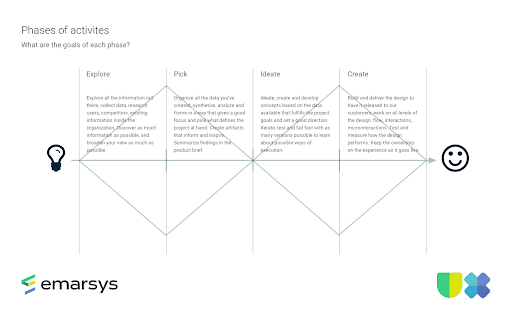
To address this, I introduced a common UX process based on Design Council’s Double Diamond model. I led the team in adapting it to fit our specific needs, ensuring it provided a flexible approach rather than a rigid set of rules.

A key part of this new process was requiring a design brief to be created in the middle. This single artifact served as a bridge, forcing us to summarize our research and formally define the problem before jumping into solutions. This approach was crucial to making better product decisions with discovery and provided a clear framework for how we’d work as a team.

The results were clear: the process organized our activities and proved scalable for any project size. The design brief became a particularly powerful tool, giving our designers clear, focused goals, and communicating design goals to our partners. The brief itself was simple, but it changed how the team thought about their work, and how our partners understood what we were doing and why.