Build a horizontal framework with AI
Canonical has a wide portfolio of over 60 deeply technical products. After I joined, I recognized that this breadth makes it increasingly challenging to have meaningful conversations about target user segments across marketing, sales, product, design, and engineering. There was a good understanding of the audience in the product teams through community engagement and plenty of dogfooding, but transmitting learning between teams was where things broke down. This led to friction both within a single product’s experience and cross-product experiences in the portfolio, for example sales not targeting the right type of customers.
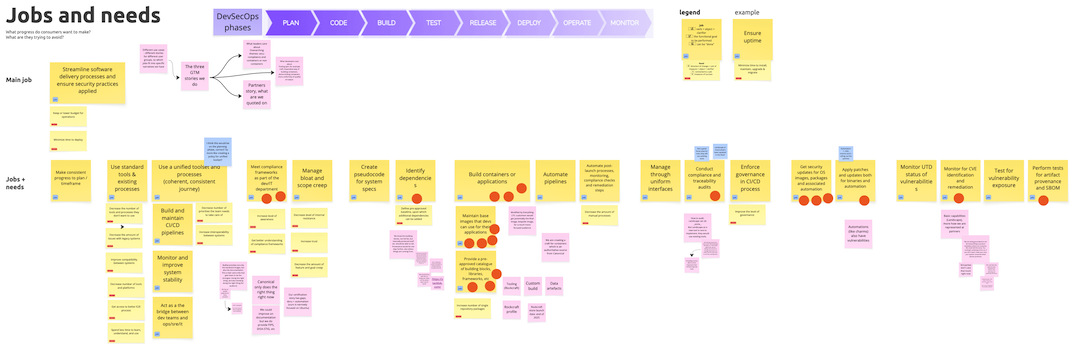
I decided to change to take on this challenge to improve the business. As a first exploratory step, I worked with the marketing team to describe a single segment of our audience using the JTBD framework. I’ve led several workshops with senior stakeholders as a source of data. Besides the concrete benefit, the goal was to understand the problem and pitch a solution to leadership. The first round was successful enough that we expanded it into a proper project team to create a framework for both positioning products and measuring their performance using a mix of customer journey, jobs to be done, and persona methods. The framework was intended to provide common terminology and a set of artifacts that could drive conversations across silos, not just within design.
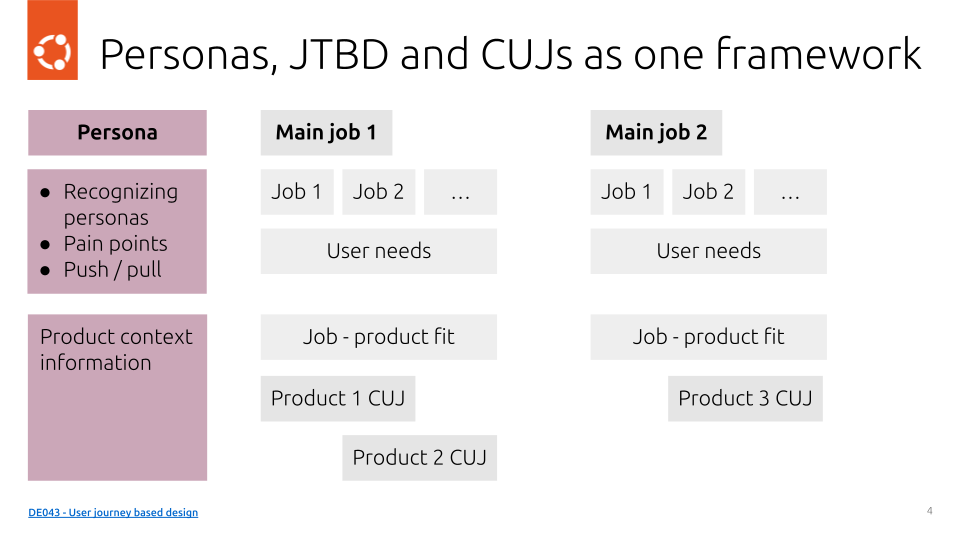
This project could have grown into something very expansive, so we searched for a key leverage point. During our exploratory conversations with stakeholders across 10+ teams, we found out that a shared description of the target audience would help the widest range of teams. Sales could better understand the customer teams they were working with, marketing could plan campaigns more precisely, product managers could write more targeted content, engineering could improve their documentation, and design would have clearer design targets.
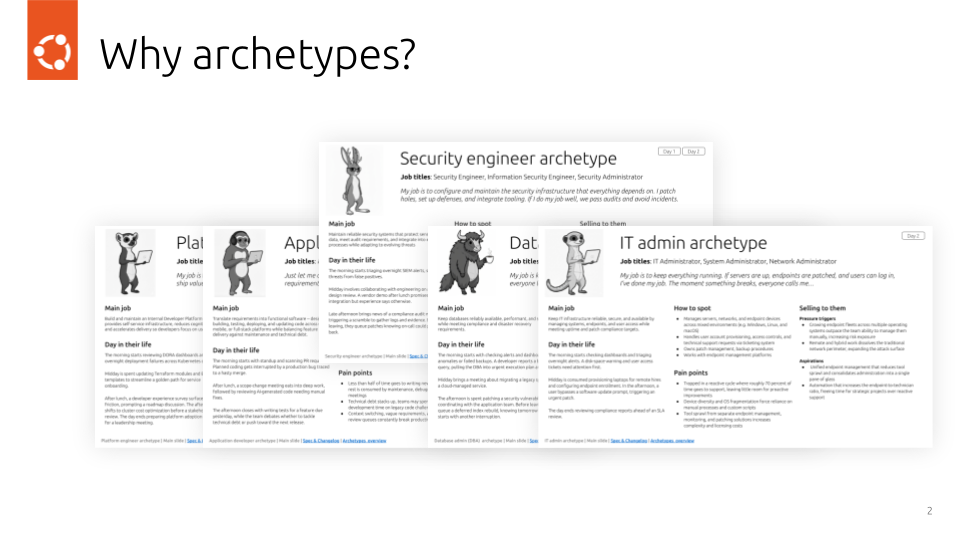
With this in mind, we created a set of archetypes. I designed a two-tier system: a strategic tier with cross-portfolio archetypes relevant for sales and marketing efforts spanning multiple products, and a tactical tier with product-level personas offering vertical depth for product teams. The key design consideration was that this had to be a system that evolves as teams learn, not a set of static artifacts that go stale.
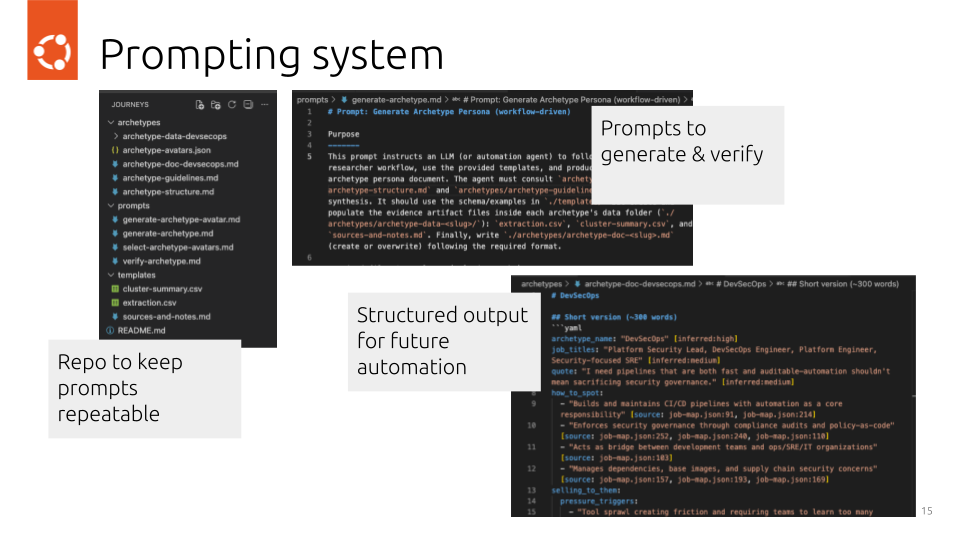
This is where the AI workflow came in. Personas tend to decay as teams accumulate new information that never makes it back into the original documents. To solve this, I designed an AI-assisted workflow using LLMs with a prompting system that continuously synthesizes and integrates new information from across the organization, creates updated archetypes, and validates them against sources. This keeps the system alive, as new learning get absorbed rather than lost, and the archetypes stay current without requiring a full research cycle every time something changes.
The new archetypes were immediately adopted by the sales team, we helped them by designing new onboarding and training artifacts. The marketing team used them to update their battlecards and bring more direction to messaging workshops and content plans. Over time, we also ran workshops with product teams using the tools we designed for them to work with the archetypes in their own context. The most interesting outcome wasn’t any single artifact. It was that teams across the organization now had a shared language for talking about users, and a system that keeps that language grounded as their understanding grows.